
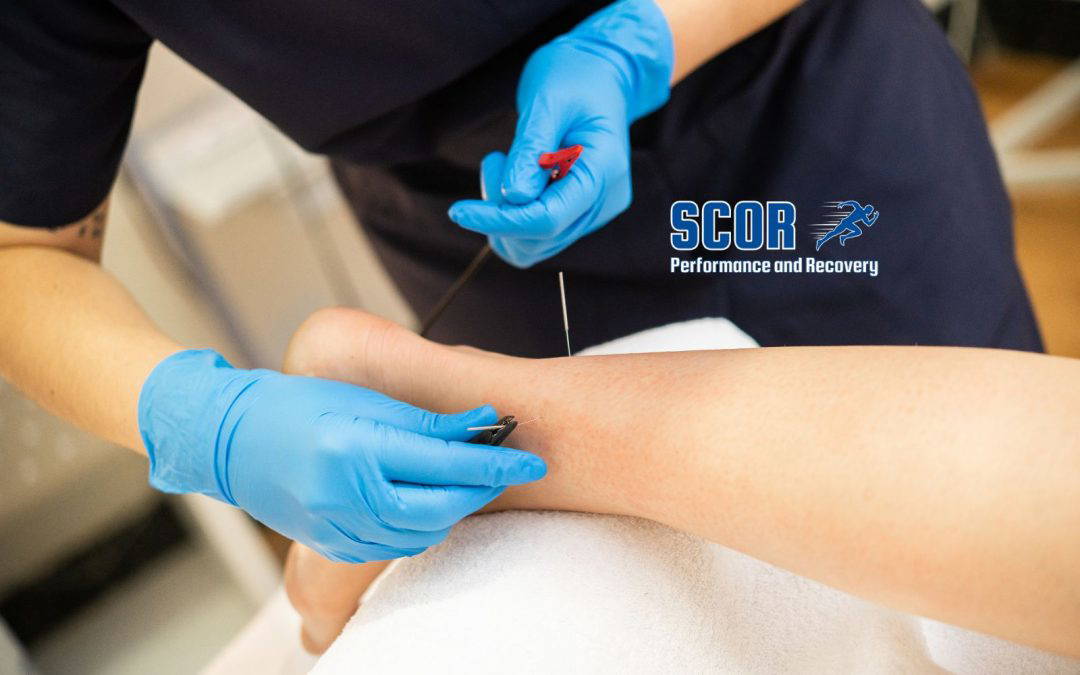
If you've never tried dry needling before, it's completely normal to have questions about what it feels like. One of the most common questions we hear at SCOR Performance and Recovery is:
“Does dry needling hurt?”
The short answer is: you may feel a brief sensation, but most people find dry needling much more comfortable than they expected.
The needles used for dry needling are extremely thin, and the experience is very different from getting a shot or having blood drawn. Your physical therapist will explain what they're doing, what you may feel, and why dry needling may be helpful for your particular problem before treatment begins.
What Does Dry Needling Feel Like?
The needle used for dry needling is very thin, so many people barely notice the initial insertion.
You may feel a small "tap" or pressure as the needle passes through the skin, but it is typically brief. Because there is no medication being injected, dry needling is different from receiving an injection.
Once the needle is positioned, you may feel very little at all.
Sometimes the targeted muscle will produce a brief twitch response. This is an involuntary contraction of the muscle and can feel like a quick tap, twitch, or brief cramp.
Not everyone experiences a twitch response, and you do not need to experience one for dry needling to be effective.
The goal of treatment isn't to create discomfort. The goal is to use dry needling, when appropriate, as one tool to help improve pain, muscle function, mobility, or your ability to move.
What About the Twitch Response?
The twitch response is one of the sensations people sometimes notice during dry needling.
When it occurs, it may feel like a quick muscle jump or a brief, deep ache. It usually lasts only a moment before the muscle relaxes again.
Some people notice that the area feels looser or that movement feels easier afterward. Others may not notice an immediate change and that's completely normal.
Your response to dry needling can vary depending on the muscle being treated, your current symptoms, and your individual sensitivity.
Dry needling should never be about “toughing it out.” Your comfort matters, and your physical therapist can adjust the treatment based on how you're responding.
Will I Be Sore After Dry Needling?
Some people experience mild soreness after treatment, while others have little or no soreness.
If soreness does occur, it is often similar to the feeling you might experience after a new or challenging workout. It typically settles relatively quickly.
You may also notice a small amount of bruising at the treatment site. This can occasionally happen because muscle tissue contains small blood vessels.
Normal movement and light activity are generally encouraged after treatment, although your physical therapist may modify your activity depending on what you're being treated for and what your training schedule looks like.
If you're an athlete, we'll also consider your workouts, practices, competitions, and recovery schedule when deciding when and how to use dry needling.
Is Dry Needling Safe?
When performed by a properly trained and licensed healthcare professional, dry needling is generally considered a safe treatment technique.
At SCOR Performance and Recovery, we use single-use, sterile needles and follow appropriate safety and hygiene procedures throughout treatment.
Before beginning dry needling, we'll review your health history and make sure the treatment is appropriate for you.
There are situations where dry needling may not be appropriate, which is why a proper evaluation and conversation with your physical therapist are important.
And if you're nervous about needles, tell us.
You don't have to be comfortable with the idea of dry needling before you come in. We can explain the process, answer your questions, and determine whether it's something that makes sense for you.
Do I Have to Get Dry Needling?
Absolutely not.
Dry needling is simply one of many tools that a physical therapist may use.
At SCOR Performance and Recovery, treatment isn't built around one technique. Your plan is based on your goals, your symptoms, your movement, your strength, and what will help you get back to doing the things you enjoy.
Depending on your needs, treatment may include:
- Strength training
- Mobility and movement exercises
- Manual therapy
- Dry needling
- Shockwave therapy
- Cupping
- Blood flow restriction training
- Recovery strategies
- Sport-specific rehabilitation
The goal is not to find the one “magic” treatment. It's to find the right combination of treatments and exercises to help you move better, feel better, and perform at your best.
So, Does Dry Needling Hurt?
For most people, dry needling is a lot less uncomfortable than they expected.
You may feel a brief pinch when the needle is inserted depending on the location, and you may notice a quick twitch or ache. Some people experience mild soreness afterward, while others don't.
Most importantly, you are in control of the experience.
We'll explain what we're doing, why we're doing it, and what you can expect. If something doesn't feel right, you can always let us know and we can modify or stop the treatment.
Dry needling isn't something you have to “push through.” It's simply another tool we can use when we believe it can help you reach your goals.
If you're dealing with nagging pain or an injury that's keeping you from training, competing, or doing the activities you love, schedule an evaluation at SCOR Performance and Recovery to find out what approach is right for you.
Book a dry needling session or call (234) 380-6182 and ask about it first. SCOR Performance & Recovery, 4968 Darrow Rd., Stow, OH.
Related: Dry Needling in Stow, Ohio · Dry needling vs. acupuncture